Industrial Marine Species Extinction and Ocean Exploitation
- Helena Constela
- Feb 2
- 8 min read

In Part 1 of this exposé, we explored a phenomenon that is as much psychological as it is ecological, the systematic erasure of ocean wildlife. But to understand why these losses are tolerated, we must confront the reality of industrial marine species extinction and ocean exploitation driven by global fleets and subsidized extraction.
We pulled back the curtain on the violence of industrial fishing and the circumstances that allow industrial extraction to masquerade as sustainability. If you haven’t read it yet, we highly recommend starting with Industrial marine biodiversity loss and ocean destruction to understand how we reached this point of ecological amnesia.
But understanding the what and the how of this destruction is only a part of it. To truly grasp why this erasure continues unabated we have to look at the structures of power, the hidden subsidies, and the deliberate obfuscation that keep the global public in the dark.
From theory to testimony: The cost of the industrial curtain
While the erasure of the ocean happens quietly in our minds and our history books, it happens violently on the High Seas. To understand the mechanics of this disappearance, we must look at the individuals, the species and the people, who are being caught in the gears of this global extraction machine.
The following accounts are the logical conclusion of an industry that has prioritized the efficiency of the kill over the survival of the source. From the prehistoric giants of the deep to the human observers who try to protect them, the ocean is being emptied by design.
We begin with a titan that has outlived the dinosaurs, but may not survive the decade.
Industrial Marine Species Extinction and Ocean Exploitation: The Pacific Leatherback
The Pacific Leatherback Turtle (Dermochelys coriacea) is a survivor from the age of dinosaurs. It is the largest turtle on Earth, capable of diving to depths of 1,000 meters. Yet, it cannot survive the industrial curtain of longlines that now crisscrosses the Pacific.
The Western Pacific Leatherback population has declined by more than 80% in less about 40 years, since the 1980s. The cause is the pelagic longline fishery. Longlining involves setting a main line, often stretching 50 to 100 kilometers, rigged with thousands of baited hooks. These lines drift in the water column, targeting tuna and swordfish, killing everything in between.

The probability of death:
Saturation: Billions of hooks are set in the world’s ocean every year. The overlap between Leatherback migration corridors and fishing grounds is nearly total.
The hooking: Leatherbacks mistake the bait for food (as they are designed to cause) or simply swim into the lines. Once hooked, they cannot surface to breathe and slowly drown. Even if released alive, the trauma of the hook or the line trailing from their mouth can be fatal.
The failure of mitigation:
Despite “mitigation” efforts like circle hooks, the massive volume of gear makes the ocean unsafe. The Leatherback is being outcompeted for its own habitat. The species is now listed as one of the NOAA Species in the Spotlight, an initiative to spotlight and “save” marine species most at-risk of extinction in the near future.
The sawfish: Trophy hunting and entanglement
The Sawfish (family Pristidae) is perhaps the most morphologically distinct fish in the ocean, and also one of the most imperiled. They are named for their long, toothed rostrum (snout) which they use to stun prey. This evolution has become their curse.

Global disappearance:
Sawfish are presumed extinct in 46 nations where they once thrived.
All five species are listed as Endangered or Critically Endangered.
In the United States, the Smalltooth Sawfish has seen its habitat contract to a tiny fraction of Florida’s coast.
For them, the decline is driven by the gillnet. The sawfish’s rostrum is easily entangled in any type of mesh. Once caught, they are incredibly difficult to remove. For decades, they were also targeted as trophies; the “saw” was cut off and sold as a curio or displayed in bars, while the animal was discarded.
Every now and then, we see images of endangered Narrow Sawfish piled up, dead in gillnets, or washed ashore with their fins and saws hacked off. This mutilation is often done to hide the evidence of catching a protected species or to sell the parts on the black market. The sawfish is being driven to extinction by a combination of bycatch negligence and opportunistic trophy hunting.
The ghost of the grand banks: economics of extinction and history being repeated
The collapse of the Northern Cod serves as the historical warning that the industry refuses to listen. For 500 years, the Grand Banks of Newfoundland were the richest fishing grounds in the world. It was said that one could walk across the water on the backs of the cod.
In the 1960s, the introduction of factory freezer trawlers changed the dynamic forever. These massive vessels could stay at sea for months, trawling deeper and harder than ever before.
Catches peaked at 810,000 tonnes in 1968. By 1992, the biomass had fallen to 1% of historical levels, and the Canadian government was forced to close the fishery, resulting in the largest industrial layoff in Canadian history.
Thirty years later, the cod have not returned to commercial viability. The ecosystem underwent a “regime shift.” With the large predators removed, forage fish and crustaceans exploded in numbers, eating the cod eggs and preventing the population from rebuilding.
Today, we are repeating this cycle with the Pacific Bluefin Tuna. Populations have dropped to less than 3% of historic levels, yet the market response is perverse. Instead of closing the fishery, the scarcity has driven prices up. A single Bluefin can sell for millions of dollars at auction in Tokyo, creating a hyper-incentive to hunt down the very last fish.
This is the economics of extinction: as a species becomes rarer, it becomes more valuable, ensuring its destruction.

The lawless High Seas: Distant water fleets and geopolitics
The destruction of marine biodiversity is not evenly distributed. It is driven by powerful Distant Water Fleets (DWF), nations that have depleted their own waters and now send industrial armadas to strip-mine the high seas and the Exclusive Economic Zones (EEZs) of other (usually developing) nations.
The Galapagos swarm
Back in 2020, when we were busy dealing with COVID-19, the ocean witnessed the scale of an infamous operation when another fleet of over 350 Chinese fishing vessels massed on the border of the Galapagos Marine Reserve.
AIS Dark: Analysis of satellite data revealed that these vessels frequently turned off their Automatic Identification Systems (AIS), ”going dark”, for hundreds of hours. This indicates probable incursions into the protected waters of the Galapagos to poach sharks and tuna.
Transshipment: These fleets can stay at sea for years because of transshipment, the practice of offloading catch to refrigerated cargo ships at sea. This washes the catch, mixing legal and illegal fish, and allows vessels to avoid port inspections where labor abuses or illegal shark fins might be detected.
The plunder of West Africa
In West Africa, the situation is a humanitarian disaster. European and Chinese trawlers have decimated the fish populations of Senegal, Ghana, and Mauritania.
These vessels, often subsidized by their home governments, use bottom trawls to scour the seabed, and the ecological collapse has driven a migration crisis. With their livelihoods destroyed, young Senegalese are forced to board dangerous boats to attempt the crossing to the Canary Islands and Europe. The “migrant crisis” in Europe is, in many ways, a fisheries crisis.
More on the human cost: Murder at sea
The final layer of this cover-up is the violence directed at those who try to expose it. Fisheries Observers (the inspiration for the Seaspiracy Observer substack name) are independent scientists mandated to work on board fishing vessels to record catch data and report violations. They are the eyes of the law in a lawless world.
But the observers are disappearing. These are just three of the latest victims:
Keith Davis: An American observer who vanished from a vessel in the Pacific in 2015 while transshipping. His case remains unsolved.
Eritara Aati Kaierua: A Kiribati observer found dead on a Taiwanese vessel in 2020 with blunt force trauma to the head. The investigation was fraught with delays and opacity.
Charlie Lasisi: An observer in Papua New Guinea who disappeared after reporting illegal catches. The crew members suspected of murdering him were acquitted due to lack of evidence, a common outcome when the crime scene is a ship in the middle of the ocean.
Whenever an observer vanishes under suspicious circumstances, a predictable script plays out: the captain and crew immediately point the finger at the victim, usually dismissed as a tragic accident. Without a body, the truth is buried at sea, leaving investigators with nothing but circumstantial evidence that rarely holds up.
Harassment, intimidation, and bribery of observers are systemic. When the “cops” are being murdered or terrified into silence, the data we rely on for “sustainable” quotas becomes fiction.
The seabed war: Bottom trawling and ghost gear
Beneath the surface wars, there is the physical destruction of the habitat. Bottom trawling is the marine equivalent of clear-cutting a rainforest to catch a squirrel.
Sediment plumes: Trawling resuspends 22 gigatons of sediment annually, more than all the world’s rivers combined. This releases stored carbon, accelerating climate change, and smothers deep-sea life.
MPA violation: In a shocking display of regulatory failure, bottom trawling is still permitted in many European “Marine Protected Areas.” In Spain, the government had to be sued to stop trawlers from bulldozing supposed sanctuaries.
The end of the line
The evidence assembled here and in the previous part paints a picture of a global industry that is fundamentally at war with the ecosystem it exploits. We are witnessing the systematic removal of life from the ocean.
We have lost the abundance (shifting baselines).
We are losing the architects (corals and seafloor via trawling).
We are losing the giants (whales, sharks, turtles via bycatch).
We are losing the foundation (krill and sandeels continuously overfished).
The extinction of species gone forever are not accidents. They are the calculated collateral damage of a business model that prioritizes extraction over existence. The labels of “sustainable” seafood mask a supply chain tainted by slave labor, observer murder, and the annihilation of endangered species.
The ocean is resilient, but it is not infinite. To reverse this, we must move beyond the illusion of “better management” and confront the reality of the industry itself. The gillnets, the bottom trawls, and the uncontrolled longlines are weapons of mass destruction. Until they are removed from the water, the ocean will continue to empty, leaving us with a silent, blue desert.
The current state of the ocean’s victims
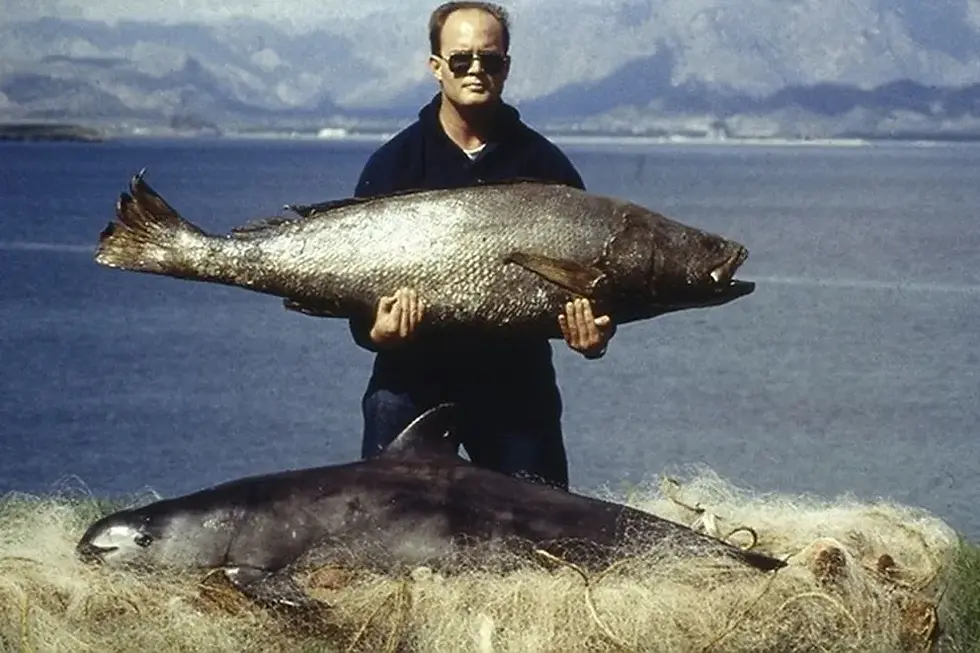
Vaquita
Primary threat: Illegal gillnets (to catch totoaba)
Current populations: ~10 Individuals
Projected future if the situation doesn’t drastically change: Extinction Imminent
N. Atlantic Right Whale
Primary threat: Pot/Trap ropes
Current populations: ~340 Individuals
Projected future if the situation doesn’t drastically change: Extinction by 2040
Oceanic Whitetip Shark
Primary threat: Longlines & FADs
Current populations: 98% Decline
Projected future if the situation doesn’t drastically change: Commercial extinction (when a population is so depleted that it is no longer financially viable to harvest.)
Pacific Leatherback
Primary threat: Longlines
Current populations: >80% Decline
Projected future if the situation doesn’t drastically change: Extinction in the Pacific Ocean
Steller Sea Lion
Primary threat: Pollock Trawling
Current populations: 80% Decline
Projected future if the situation doesn’t drastically change: Chronic nutritional stress (a prolonged state of physical decline happening when overfishing deprive them of the consistent, high-quality food sources needed for growth and reproduction.)
Sawfish
Primary threat: Gillnets and trophy hunting
Current populations: Extinct in 46 nations
Projected future if the situation doesn’t drastically change: Global extinction
The clock is ticking. For some species, it is seconds to midnig


This article raises an important issue that deserves much more attention. The impact of industrial exploitation on marine ecosystems is something that affects everyone, even if we don’t always see it directly. I appreciate that the topic is presented with enough detail to encourage readers to learn more instead of relying on assumptions. It reminded me how valuable well-organized comparison resources can be in completely different fields. For example, it.casinohex.it/casino-online/europei provides a clear overview of European online casinos, explaining their differences and helping readers compare available options instead of focusing on just one. While the subjects are unrelated, both resources share the same strength: they present information in a structured, informative way that helps people make better-informed decisions based on…
Girl games online is so good
The scale of industrial fishing wiping out keystone species before we even understand their role is terrifying—your breakdown of the bycatch data really drives that home. I've been tracking similar collapse patterns with a monitoring tool that's been eye-opening. https://aiphoto-editor.com
This is exactly the type of content I was hoping to find. While looking for 192.l68.1.1, I came across your guide and learned useful techniques for accessing router settings, improving wireless performance, strengthening security, and managing my network effectively.
The push to catalog industrial fishing's toll before these species vanish entirely is exactly the kind of hard data we need, not just another doom report. I've been tracking the overlap between trawling routes and extinction hotspots myself, and this piece finally puts the pieces together—check out the interactive map they linked in the sidebar for https://hunyuan3d.dev