Industrial marine biodiversity loss and ocean destruction
- Helena Constela
- Feb 2
- 9 min read

The ocean is the greatest optical illusion in human history, a vast blue expanse that disguises a deeper truth: industrial marine biodiversity loss and ocean destruction are occurring right beneath the surface.
This opacity has allowed the industrial fishing complex to wage a centuries-long war of attrition against marine life, unnoticed by the public. We are not just witnessing the “management of natural resources”; we are documenting a systematic biological annihilation that has driven ancient, keystone species to the very precipice of extinction.
Industrial Marine Biodiversity Loss and Ocean Destruction: The Great Amnesia and the Shifting Baseline Syndrome
The crisis we face today is not just one of biology, but of memory. We suffer from a collective psychological condition known as “Shifting Baseline Syndrome.”
Coined by fisheries scientist Dr. Daniel Pauly in 1995, this concept explains why humanity tolerates the intolerable. Each generation of scientists, fishers, and consumers accepts the state of the ocean they encounter at the beginning of their lives as the “normal” baseline.
When a young fisher today casts their nets and returns with a fraction of what their grandfather would have caught, they do not see a collapse; they see a successful day. We celebrate the “recovery” of fish populations that are stabilized at 5% or 10% of their historical population, mistaking the management of ruins for conservation.
To understand the magnitude of what has been stolen, we must look back before the industrial age. In the 17th century, the ocean was a different planet. When Christopher Columbus sailed through the Caribbean in the late 15th century, he described the seas near Cuba as being “thick with turtles,” so numerous that it seemed his ships would run aground on them.
Historical logs from the Cayman Islands and the Gulf of Batabanó describe green sea turtles in numbers estimated between 33 and 39 million adults in the Caribbean alone. They were a biological dominance that defined the seascape. Today, those populations are a shadow of the “mother sea” that once existed.
This report is an autopsy of the decline. It is an investigation into the specific species that the fishing industry has sacrificed on the altar of commerce.
We are not discussing the concept of “overfishing”, but the targeted or collateral erasure of the Vaquita, the North Atlantic Right Whale, the Oceanic Whitetip Shark and the foundational forage fish that support the entire web of life.
We are fishing “through” the food web, simultaneously decimating apex predators with bycatch while strip-mining the prey they depend on. The ocean is not dying of natural causes. It is being emptied.
The Vaquita: the price of aquatic cocaine
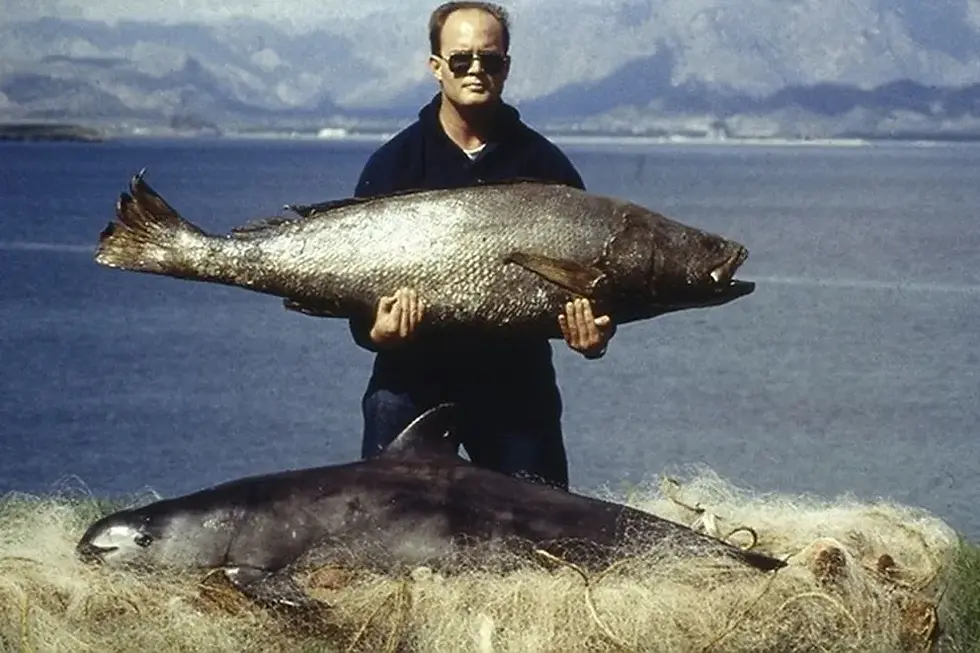
In the waters of the Upper Gulf of California, the world’s smallest cetacean is blinking out of existence. The Vaquita (Phocoena sinus), a shy porpoise with dark rings around its eyes has been reduced to a population of approximately ten individuals. This is not a slow decline; it is a freefall driven by the violent economics of the black market.
The extinction of the Vaquita is a distinctively modern tragedy because the animal itself is of no commercial value. It is not hunted for its meat or oil. It is bycatch. Trash to be discarded in the pursuit of another critically endangered species: the Totoaba (Totoaba macdonaldi).
The Totoaba is a large sea bass, endemic to the same waters, whose swim bladder is highly prized in traditional Chinese medicine. Despite a complete lack of scientific evidence regarding its medicinal properties, the dried bladder is valued for its supposed ability to boost fertility.
Fishers in Mexico can get thousands of dollars for a single pound of Totoaba swim bladder. This price tag equivalent to half a year’s income from legal fishing has fueled a “gold rush” mentality. The Totoaba bladder has been called “the cocaine of the sea” for its high value and the cartels that now control its trade.
To catch the Totoaba, poachers use gillnets, which are indiscriminate killers. They are designed to entangle fish by their gills, but they are perfectly engineered to entrap the Vaquita. The Vaquita is a mammal; it must surface to breathe. When it swims into a gillnet, the fine mesh wraps around its body. In its panic to escape, it rolls, tightening the net further. Trapped underwater, the Vaquita drowns in the dark.
The failure of enforcement
1997: The population was estimated at nearly 600 vaquitas.
2008: The number dropped to 250.
2015: As the illegal Totoaba trade exploded, the population crashed to fewer than 60.
2025: We are left with about 10 survivors (including two calves).
This extinction is happening despite the existence of the “Vaquita Refuge” and a ban on gillnets. The enforcement has been overwhelmed by the profitability of the illegal trade. Authorities have struggled to police the Gulf against well-armed poachers backed by organized crime syndicates, while the demand in China continues unabated.

The fishing industry’s responsibility extends far beyond the illegal poachers though. For decades, the legal shrimp fishery in the Gulf of California has been using the same types of gillnets that kill Vaquitas. The infrastructure of the fishing port, the presence of nets, and the tolerance of “bycatch” as a cost of doing business created the cover under which the illegal Totoaba trade flourished. We are now watching the final gasps of a species that has existed for millions of years, erased in a few decades for a dried piece of fish organ, or a handful of shrimp in a cocktail glass somewhere in Europe or the US.
The North Atlantic Right Whale: strangled by “sustainability”
There are approximately 380 North Atlantic Right Whales remaining on the planet. Of these, fewer than 70 are reproductive females. The species is in a steep decline, with a projection of functional extinction by 2040 if current mortality rates continue.
The primary killer here is the vertical line. The lobster and crab industries in the United States and Canada deploy millions of traps on the seafloor. Each trap (or string of traps) is connected to a surface buoy by a heavy-duty rope. As Right Whales migrate along the Eastern Seaboard to their feeding grounds, they must navigate a dense forest of these vertical lines.
The statistics of entanglement are horrifying. More than 85% of the entire population bears the scars of being entangled in fishing gear at least once in their lives. It is a rite of passage for the species.
When a 40-ton whale hits a modern fishing rope, the outcome is catastrophic. Unlike the natural fibers of the past, modern polymer ropes are incredibly strong. They do not break. Instead, the rope wraps around the whale’s flippers, tail, or body. As the animal swims, the rope constricts, slicing through blubber and muscle, often sawing down to the bone.
Death by entanglement is a slow, agonizing process that can last for months or even years. The drag of the gear exhausts the whale, preventing it from feeding properly. This creates a state of chronic energy deficit.

Reproductive Collapse: The stress of carrying heavy gear means that females cannot build up the fat reserves needed to become pregnant or nurse their calves. The calving intervals have increased, and the birth rate has plummeted.
The “Unusual Mortality Event”: Since 2017, NOAA has declared an “Unusual Mortality Event”. At least 45 whales have been confirmed dead or seriously injured, but the true toll is likely closer to 100, as many carcasses sink unseen in the deep ocean.
The forage fish robbery: starving the foundation
While the killing of the whales captures headlines, a more systemic destruction is happening at the base of the food web. This is the crisis of “forage fish”, the schooling species like sandeels, herring, anchovies, and krill that transfer energy from plankton to predators. The industrial extraction of these species constitutes a form of ecological theft, starving the ocean’s predators to feed terrestrial livestock and aquaculture operations.
The Sandeel and the Puffin: A North Sea Famine
In the North Sea, the sandeel (Ammodytes marinus) is the currency of life. These small, eel-like fish bury themselves in the sand and form massive shoals that feed Atlantic Puffins, Kittiwakes, and Razorbills. They are high in lipids, essential for seabird chicks to grow.
For decades, industrial trawlers have targeted sandeels not for human consumption, but for reduction into fishmeal and fish oil. This industrial slurry is used to feed pigs, chickens, and farmed fish. We are effectively vacuuming the ocean’s wild protein to create cheaper bacon and farmed fish.
The ecological consequences have been devastating.
Breeding failure: As sandeel stocks collapsed under fishing pressure, seabird colonies began to fail. Puffins, unable to find the sandeels they need, were seen bringing back pipefish, hard, bony, and nutritionally poor, to their chicks. The chicks starved in their burrows.
The trophic cascade: When the UK government finally announced a closure of the industrial sandeel fishery in the North Sea in 2024, ecosystem modeling predicted a massive rebound. Stopping the fishery is projected to increase seabird biomass by 42%. This confirms that the industry was directly competing with, and winning against, the seabirds.

This die-off (over 300 puffin chicks) was considered a sign of trouble for all sorts of species.
The Steller Sea Lion: starvation in Alaska
A similar dynamic played out in the North Pacific, leading to the catastrophic decline of the Steller Sea Lion. Between the late 1970s and the 1990s, the western population of Steller Sea Lions crashed by over 80%. This collapse coincided with the intensification of the pollock fishery, the largest food fishery in the world, responsible for the billions of fish sticks and imitation crab meat products sold globally.

Industrial trawlers are hyper-efficient predators. They target the same dense schools of pollock that nursing female sea lions rely on. By breaking up these schools and reducing the local density of prey, the trawlers forced sea lions to expend more energy hunting for less food. The sea lions in the declining areas showed classic signs of acute nutritional stress (smaller bodies, lower birth rates, and higher mortality). They were starving in an ocean that the industry claimed was full of fish.
Antarctic krill: the final frontier of extraction
The most alarming frontier of forage fishing is now the Southern Ocean. Here, super-trawlers are targeting Antarctic Krill (Euphausia superba), the keystone species that supports every penguin, seal, and whale in Antarctica.
The krill fishery is driven by two markets: aquaculture feed (to give farmed salmon their pink color) and now-trendy Omega-3 dietary supplements for humans.
Vacuuming the ocean: Modern krill vessels pump catch continuously from the water. They do not fish randomly; they use sonar to locate the same super-swarms that whales depend on.
Impact on whales: The recovery of baleen whales in the Antarctic is being jeopardized. Recent studies have found a correlation between localized krill depletion by fisheries and reduced pregnancy rates in humpback whales.
Climate Stress: Krill are already under siege from climate change, as the sea ice they need for their larval stage melts. The fishery adds a second, lethal stressor. We are literally grinding up the foundation of the Antarctic ecosystem to produce vitamin pills.

The shark fin and FAD crisis: industrial slaughter on the high seas
The primary weapon in this war on sharks is the Fish Aggregating Device (FAD), used extensively by the tuna purse seine industry. A FAD is a floating raft, often equipped with satellite-linked sonar buoys, deployed to attract tuna. In the open ocean, any floating object acts as a magnet for life. Small fish gather, followed by tuna, and inevitably, sharks.
Tuna vessels deploy tens of thousands of these devices, drifting across the ocean. When they return to circle the FAD with a purse seine net, they catch everything around it.
The “Bycatch” Myth: The industry refers to sharks as “accidental” catch, but when you set a net around a device designed to aggregate predators, the catch is statistically inevitable.
Ghost Fishing: The FADs themselves are lethal. Many use “hanging nets” beneath the raft to create drag. Sharks, particularly Silky and Oceanic Whitetip sharks, become entangled in this mesh. Research suggests that shark mortality from entanglement in drifting FADs is 5 to 10 times higher than the bycatch recorded in the nets. The sharks die and fall away, uncounted, ghost-fished by abandoned gear.

Shark entangled under a FAD
The oceanic whitetip: from “most dangerous” to critically endangered
The case of the Oceanic Whitetip Shark (Carcharhinus longimanus) is emblematic of this crash. In the mid-20th century, this species was considered one of the most abundant large animals on Earth. Famed explorer Jacques Cousteau once described it as “the most dangerous of all sharks” due to its ubiquity and boldness around shipwrecks.
Today, the Oceanic Whitetip is Critically Endangered.
Pacific crash: In the Pacific Ocean, populations have declined by 80% to 95% since the mid-1990s.
Gulf of Mexico: Populations have plummeted by 88%.
The Cause: They are caught in massive numbers by tuna longlines and purse seine FADs. Their large, paddle-like fins are highly valued in the shark fin trade, so fishers keep them even when caught as “bycatch”. A species that once dominated the tropical oceans has been reduced to a ghost, driven to the brink by the global appetite for canned tuna and shark fin soup.

To be continued… The Cover-Up of the Century
The systematic annihilation of ocean life is a global erasure that is too long for one report. We will return with part two to expose the remaining “casualties” of this industrial machine: from the dinosaur-era Pacific Leatherback to the vanished Sawfish and the lawless plunder of the High Seas. The industry has spent decades operating in the shadows, converting the ocean’s living abundance into a silent desert. This is the reality they don’t want you to see.


Vừa mở lên là thấy giao diện kiểu đồng bộ thật, bấm qua lại không bị lệch nhịp hay phải đoán xem nút chơi nằm đâu LX88. Nội dung cũng chia thành từng khối rõ ràng nên lướt nhanh vẫn nắm được ý chính, không bị ngợp chữ. Mình thích cái cách họ viết kiểu “ăn khớp” ngay từ đầu, đọc vài dòng là hiểu họ muốn hướng tới trải nghiệm liền mạch chứ không màu mè. Kéo xuống thấy các tiêu đề và box tách bạch, nhìn phát là biết phần nào là nội dung chính, phần nào chỉ là thông tin kèm theo.
Dạo này hay thấy mọi người để link 789WIN trong mấy phần bình luận, sẵn đang cầm điện thoại nên mình cũng mở ra ngó qua chút xíu. Mình không đọc sâu vào chi tiết, chỉ vuốt từ trên xuống dưới xem cách họ chia khối nội dung. Phải công nhận là giao diện mobile khá thoáng, các khoảng trống tách bạch rõ ràng. Lướt nhanh vài phút là nắm được bố cục tổng thể mà không hề thấy rối mắt.
Khi truy cập vào xem qua các sảnh giải trí tổng hợp, mình thấy tốc độ phản hồi khá đều và ổn định. Trong quá trình đọc thêm thông tin về Sunwin, mình nhận thấy hệ thống còn tích hợp đa dạng từ thể thao, game bài cho đến esport nên tạo cảm giác trọn vẹn hơn. Các chuyên mục sảnh game được phân chia rõ nên không mất nhiều thời gian làm quen thao tác. Cá nhân mình cảm thấy tổng thể bố cục được tổ chức khá hợp lý và trực quan.
Hôm trước mình tranh thủ lướt điện thoại đọc vài bài chia sẻ trên mạng thì thấy có người gửi Link ON68 vào trong phần bình luận. Vì tò mò nên mình mở thử xem giao diện thế nào chứ không tìm hiểu quá sâu. Sau khi lướt qua vài mục, mình thấy cách trình bày khá thoáng, các danh mục được chia rõ nên việc theo dõi nội dung cũng thuận tiện hơn. Mình thử chuyển qua vài phần trên điện thoại thì tốc độ phản hồi ổn, thao tác khá mượt. Nhìn chung, bố cục được sắp xếp gọn gàng, chỉ cần lướt nhanh là cũng nắm được những phần chính trên trang.
Khi truy cập vào live casino và game bài, mình thấy tốc độ phản hồi khá đều. Trong quá trình đọc thêm thông tin về 88JBET mình nhận thấy hệ thống còn tích hợp thêm slot, esport và thể thao nên tạo cảm giác đầy đủ hơn. Các danh mục được phân chia rõ nên không mất nhiều thời gian làm quen. Cá nhân mình cảm thấy tổng thể được tổ chức khá hợp lý.