Not All Traditions Deserve to Survive: End the Faroese Dolphin Hunt
- Helena Constela
- Jan 30
- 8 min read

What Is the Faroese Dolphin Hunt and Why It Must End
Right now, as I write these lines, a grindadráp (also known as grind) is taking place on the Faroe Islands.
Just one day after World Dolphin Day.
On September 12, 2021 the world watched in horror as Sea Shepherd’s cameras captured the largest slaughter of dolphins on record: an entire pod of Atlantic white-sided dolphins was driven into a Faroese fjord and butchered.
Reports confirmed 1,428 dolphins killed that day – the single largest cetacean massacre ever documented.
How the Faroese Grindadráp Works
The Faroe Islands’ annual grindadráp (whale drive hunt) is governed by local law. Community crews of boats locate a pod (usually pilot whales, but many times other cetaceans including dolphins), encircle it, and drive it toward a sloping beach. Once beached, each animal is dispatched, theoretically, with a single-bladed lance, plunged into the spinal column between neck and head.
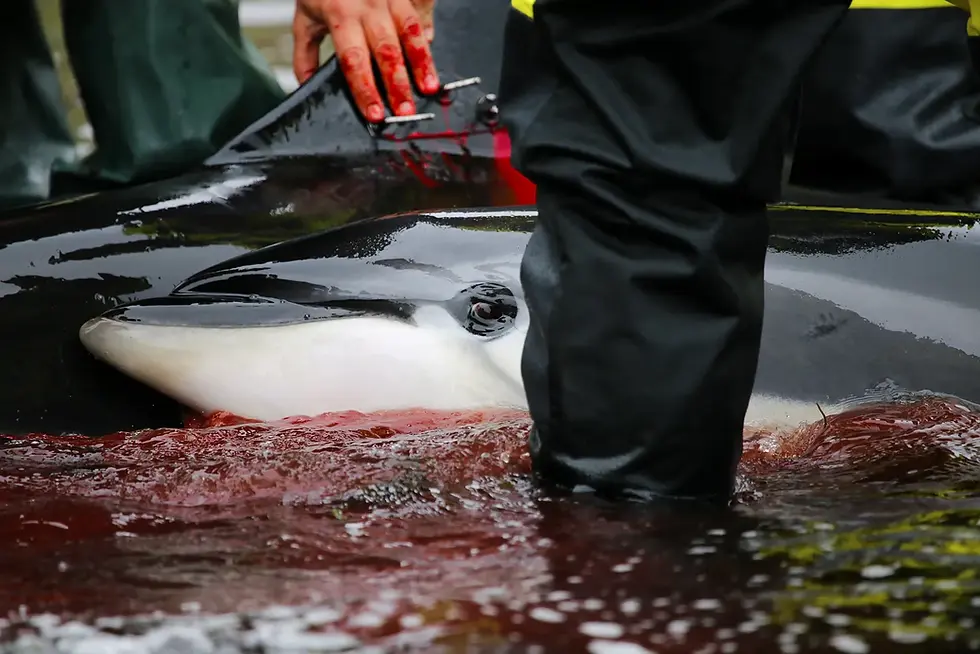
Faroese regulations even mandate participant requirements: hunters must be at least 16 years old and complete a certified whaling course. The intended aim is a “quick kill”, a single thrust of the lance, but eyewitnesses constantly report that whales and dolphins often struggle for minutes. As one of the present recounted, the 2021 pod “fought for their lives while being butchered in the shallow waters,” including juveniles and pregnant females.
Despite being promoted as a controlled harvest, the grindadráp is inherently indiscriminate. There are no fixed quotas: by law, all whales or dolphins in the targeted pod are eligible for killing. Faroese officials note that in modern times the catch has ranged from a few hundred up to over a thousand animals in a season. For example, Faroese data show that in one year 590 pilot whales were killed, and the 2021 dolphin drive itself involved the slaughter of the entire herd encountered. After the 2021 massacre, the Faroese authorities did impose a cap on dolphins – no more than 500 per year – but in practice this limit has been ignored or circumvented.
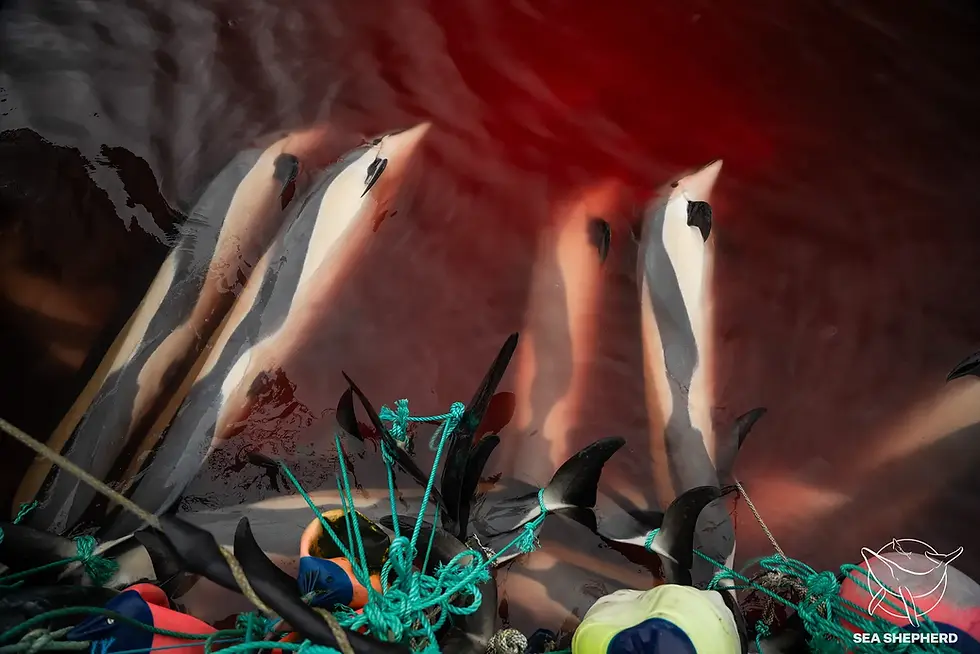
Government and police control the hunts. By law, civilians (and also foreign activists) are forbidden to interfere; attempts to disrupt a grindadráp have led to arrests.
The Faroese Fisheries Ministry oversees permissions: volunteers in 2021 found that even a non-Faroese observer could obtain a kill permit simply by watching a brief video. Only those formally certified may wield the lance – untrained citizens may not. In other words, from the chase at sea to the moment of the kill, the grind is regulated by local rules.
But those same regulatory walls extend beyond the beaches. While whale meat is still handed out as “traditional food” within the Faroes, it cannot legally travel further. Since 2006 the European Union has banned trade in whale products (also due to health reasons), and although the islands stand outside the EU, Denmark — the kingdom they belong to — enforces the rule by forbidding any import of Faroese whale meat.
From catch to carcass: the controversy over the meat
What happens to those thousands of whales and dolphins after the grind?
Officially, the meat and blubber are shared among local communities, a practice defended as a remnant of subsistence living. In reality, however, much of it goes unconsumed. In July 2022, Sea Shepherd investigators documented piles of dolphin and pilot-whale carcasses dumped back into the ocean after a grind. They just wanted to kill.

This shattered the Faroese refrain that “we eat everything” from the hunt. Locals often claim the drive provides healthy, organic food, but modern Faroese diet is already rich in fish and imported goods, and few islanders actually want cetacean meat.
Beyond waste, there are serious health concerns with consuming cetaceans.
Large whales and dolphins accumulate heavy metals and pollutants over decades. Studies in the Faroe Islands have repeatedly shown very high mercury and PCB levels in pilot whale meat and blubber.
In 2008, the Faroese Chief Medical Officer and chief scientist issued a joint advisory that pilot whale meat “should no longer be used for human consumption” due to its toxic load. They warned of mercury’s damage to fetal brain development and other health effects. A 2012 scientific review by the same team echoed this conclusion and recommended that whale products be excluded from diets. In fact, published studies find Faroese whale meat has roughly double the European Union’s legal mercury limit, with documented cases of neurodevelopmental harm in children.
As a result, current local guidelines urge men to limit whale-meat to one small meal per month at top, and pregnant women to avoid it altogether. Yet sales and sharing of grind meat continue seasonally, exposing families to poisoning risk.
International and local dissent
The grindadráp has long been internationally condemned. NGOs and foreign governments consider it a cruel survival of primitive hunting. In 2021 the European Parliament even formally urged the Faroese to halt their annual whale hunts. It is a fact that modern Faroese society does not need dolphin meat the way remote communities might have in the past.
More and more scientists and activists cite that horrific episode as evidence that the grind is no longer a sustainable harvest, but an archaic bloodsport.
This 2021 dolphin massacre also stirred unusual opposition within the Faroe Islands themselves. For the first time, many locals publicly protested killing dolphins. The Whale and Dolphin Conservation NGO reported “a lot of outrage” among islanders, with citizens demanding that only pilot whales – not smaller dolphins – be allowed in future hunts. Grassroots petitions and debates on Faroese TV questioned the need to butcher entire families of dolphins. In parliament, the Fisheries Minister was forced to say that only a strict quota (500 dolphins/year) would now stand for dolphin hunts – a concession reflecting the political impact of local dissent.
(Pilot whaling, by contrast, remains unrestricted except by annual catch tallies.) In short, even on remote Faroe, many are reassessing whether “tradition” justifies slaughter.
Still, the hunt continues. Faroese authorities insist it is a lawful cultural heritage and refuse to outlaw it. They point out that the islands are outside EU jurisdiction and therefore not bound by EU bans on whale killing. Local officials also highlight that the grind provides cheap meat and preserves heritage.
Heritage. What a word. It holds so much power that it can allow you to kill thousands in its name.
A 2022 Faroese law explicitly empowered the fisheries minister to suspend a grind for short periods (for example, during COVID lockdowns) – which has only been used twice. Apart from those rare halts, parliamentary attempts to ban or limit the grind have gone nowhere.
In practice, Faroe’s government continues to authorize hunts each year and even celebrated the 2021 grind as a successful harvest when the world was watching.
Some defiance is ideological. Calls to end the grind are often framed by Faroe nationalists as attacks on their sovereignty or way of life. For example, in 2022 Faroe leaders and fishing lobbies pointed to modern fishing quotas and argued they cannot simply throw away a perceived resource when it is legally and culturally accepted locally. Yet this stance has growing isolation: even neighboring Denmark (which still owns Greenland’s hunt) has called for more oversight, and global opinion is increasingly on the side of ending the drive. The Faroes are cooperating at some level with international bodies (they do attend IWC meetings via Denmark), so pressure at the IWC and UN forums is mounting to recognize drives as unacceptable.
When “tradition” isn’t enough
History shows that societies frequently abandon “traditional” animal-killing spectacles once public values evolve. What once passed as acceptable heritage often becomes shameful cruelty. In Spain, for instance, the centuries-old Toro de la Vega festival – in which riders on horseback stabbed a bull to death – was abruptly outlawed in 2016 by regional decree, amid mass protests. (Spain’s leadership noted that killing bulls on public streets was already illegal, and finally enforced that ban.) The last speared bull in Tordesillas ran in 2017; the festival now features no gore. Organized dogfighting, once common even in London, was made illegal in Britain back in 1835 and is now banned throughout the U.S., EU and virtually all countries as a cruel blood sport.
Fashionable fur-farming – a status symbol for centuries – has been phased out: over 25 countries have legislated to end fur production (the UK closed its mink and fox farms by 2003). And the shameful practice of forcing dancing bears on tethers for street performance – common in Europe and Asia until the 20th century – was prohibited by law (for example, India banned “dancing bears” in 1972, and NGOs have since rescued the last dancing bears worldwide).
These examples show how public sentiment can turn decisively against even deeply rooted animal-use traditions once the cruelty is laid bare.
Spain’s Toro de la Vega – horsemen used to chase and spear a bull at a medieval festival. In 2016 Spain’s regional government ended this 500-year tradition, banning the killing of bulls at festivals (except if it’s bullfighting, which is only illegal in some regions… for now).
Dogfighting – once a pastime, now universally illegal. It is now a felony in most countries as awareness of its brutality grew.
Fur farming for fashion – mainstream in mid-20th-century Europe and North America; now outlawed in many places. Dozens of nations have passed full or partial bans on fur production.
Dancing bears – a centuries-old form of entertainment, now universally condemned. Private rescue campaigns ended the spectacle entirely.
Each of the above was defended by locals as “heritage” or livelihood – until broader society said enough. The same principle applies to any blood sport: culture does not grant cruelty immunity.

Ethical standards evolve: what past generations accepted (baiting bulls, bear-baiting, cockfighting) we now recognize as inhumane.
The key moral question is not “Is this old?”, but “Is this right?”
Cognitive dissonance and the modern Faroese
Atlantic white-sided dolphins are known for their intelligence and playful nature. To the Faroese, however, they are sometimes just another “catch”.
Many Faroese thrill at watching whales on whale-watching boats, and locals pride themselves on the beauty of their clean seas. Yet those same people may also line up to kill dolphins on the beach in the name of custom.
Psychologists call this cognitive dissonance: the clash between modern values (compassion for intelligent animals) and an outdated practice (driving and stabbing them) that people feel obliged to uphold. Faroe Islands today have 21st-century schools, internet access, and connections to the global community – yet they sustain a kill that would horrify anyone else involved.
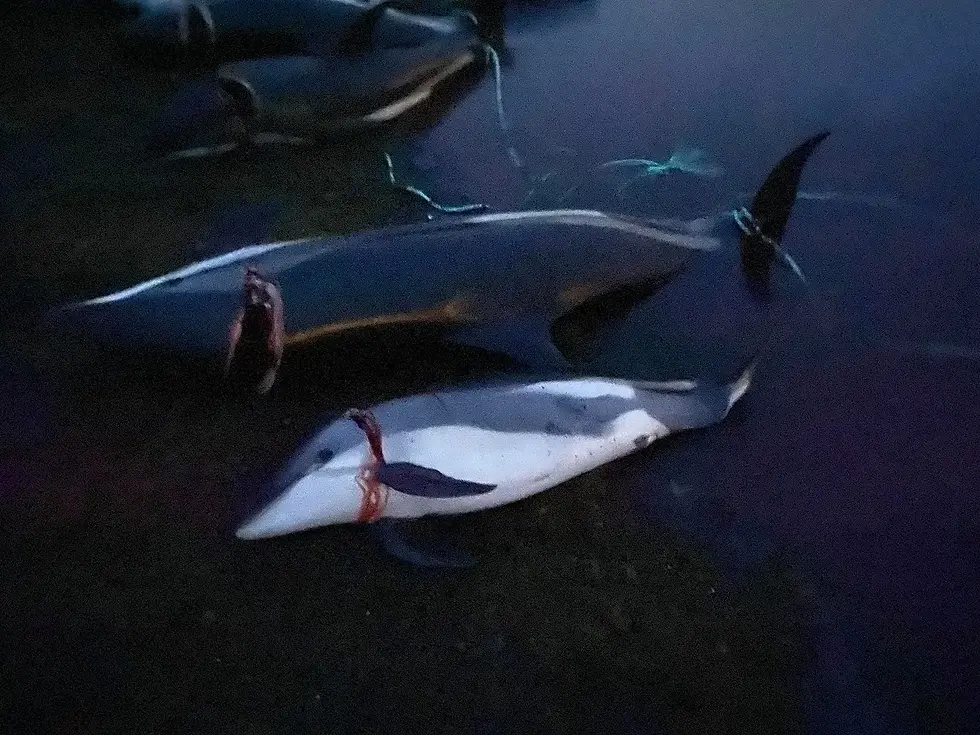
This contradiction cuts both ways. On one hand, dolphin hunting is rarely mentioned in Faroese tourism brochures or school curricula; many islanders privately admit they dislike the grindadráp or question its necessity. On the other hand, national pride can fuel defensiveness: Faroese media have portrayed external criticisms as attacks on tradition. International comparisons make Faroese whalers uneasy: when outsiders point out that the world eats salted fish instead of live dolphins, or that other Scandinavian communities abandoned whaling, locals bristle. The same lands that champion open-mindedness and animal welfare in Europe today have to explain why a “tradition” of throat-slitting continues.
Rejecting cruelty disguised as heritage
Today, the grindadráp stands at a crossroads. After centuries of invisibility, the kill is under intense scrutiny from activists, scientists, and even many Faroese themselves. A new global coalition – including Sea Shepherd, Seaspiracy and dozens of NGOs – is demanding change. So far, enough UK signatures have been gathered to prompt a parliamentary debate on suspending trade deals with the Faroe Islands over the grind. StopTheGrind has pressured industry and governments: consumer surveys in Europe found ~70% support boycotts of seafood from dolphin- and whale-hunting nations (pushing retailers to avoid Faroese products). And at international forums, they are urging the IWC (International Whaling Commission) to extend protections to small whales and dolphins. On the ground in the Faroes, Sea Shepherd volunteers continue to document every hunt, share footage of the brutality, and cultivate local support for ending it.
Some final thoughts. Stop the grind.
Dolphins are one of the most beloved creatures on the planet, yet they continue to be barbarically killed for tradition. If we cannot find the will to protect these highly intelligent, curious mammals, what hope do we have for the rest of nature?
In the end, not all traditions deserve to survive. We must judge traditions by our highest ethical standards. Dolphins deserve our compassion, not our knives.
Support the wild.


BD333 আমি হঠাৎ করে মোবাইলে একটু দেখে নিলাম, আসলে শুধু কেমন ফিল হয় সেটা বুঝতে। ভালো লেগেছে যে অ্যাপ ইন্টারফেসটা অযথা ভারী মনে হয়নি—স্ক্রল করতে বা ট্যাপ করতে গিয়ে ল্যাগ টাইপ কিছু চোখে পড়েনি। আর অ্যাকাউন্ট প্যানেলটা বেশ পরিষ্কার, কম জিনিস সামনে রাখায় কোথায় কী আছে ধরতে সহজ লাগে, নতুন কেউ হলেও গুলিয়ে যাওয়ার চান্স কম। যেটা আমার কাছে সবচেয়ে কাজে লেগেছে, অনেক তথ্য টেবিল বা গুছানো ব্লকের মতো সাজানো—এক নজরে বুঝে নেওয়া যায়, পেজটা এলোমেলো লাগে না। শেষ পর্যন্ত ওই পরিপাটি টেবিল-ধাঁচের ইনফো বক্স আর সোজা মেনু গ্রুপিংটাই সবচেয়ে চোখে পড়েছে।
GO99 hôm trước mình lướt thử vì thấy bạn bè nhắc nhiều, vào chủ yếu xem bố cục có dễ theo dõi không thôi. Trang nhìn khá thoáng, không bị nhồi chữ ngay từ đầu. Mình để ý cái khối “Bài viết mới nhất” đặt nổi bật nên kéo xuống cái là thấy liền, tiêu đề kiểu “Cách Chơi Sâm Lốc…” nhìn phát biết đang nói về gì, khỏi phải mò. Mình cũng thích cái phần gấp mở dạng accordion, bấm vào thì nội dung mới bung ra nên đỡ rối mắt, nhất là khi chỉ muốn xem nhanh chứ không đọc kỹ. Nói chung cảm giác dùng khá nhẹ nhàng, kiểu lướt vài phút vẫn nắm được trang đang…
Trong quá trình khám phá nhiều phiên trải nghiệm liên tiếp, mb66 mang lại cảm giác khá gọn gàng nhờ cách tổ chức các chuyên mục một cách hợp lý. Những danh mục như game bài, casino trực tuyến, thể thao và nổ hũ được bố trí theo từng khu vực rõ ràng giúp việc tìm kiếm diễn ra nhanh chóng hơn. Theo trải nghiệm của mình, giao diện giữ được sự đồng bộ giữa các phần hiển thị, góp phần hỗ trợ người dùng ghi nhớ vị trí và giảm thời gian thao tác. Khi chuyển đổi qua nhiều chức năng khác nhau, tốc độ phản hồi ổn định, tải trang đều và trải nghiệm sử dụng khá dễ chịu
Sau khi quan sát nhiều nền tảng giải trí trực tuyến trong cùng khoảng thời gian, mb66 mang lại cảm giác khá dễ tiếp cận nhờ cách trình bày nội dung theo cấu trúc rõ ràng. Các khu vực như casino, game bài, bắn cá và xổ số được phân chia hợp lý giúp việc theo dõi cũng như tìm kiếm diễn ra thuận tiện hơn. Mình nhận thấy bố cục tổng thể giữ được sự cân đối giữa các thành phần hiển thị, hỗ trợ người dùng sử dụng lâu mà không tạo cảm giác rối mắt. Trong quá trình điều hướng, tốc độ phản hồi ổn định, thao tác mượt và trải nghiệm khá liên tục
de88 mình mới ghé thử vì thấy mọi người nhắc hoài, vào chủ yếu xem cách họ làm giao diện thôi. Cảm giác đầu tiên là thanh menu chính chia nhóm khá gọn, nên mình bấm qua lại không bị lạc hay phải tìm lâu. Mình dùng trên điện thoại thì thấy thao tác ổn, cuộn trang và chuyển mục khá mượt, kiểu tối ưu cho màn hình cảm ứng nên đỡ bực. Có cái mình để ý là họ có đoạn ghi chú nhắc người dùng tự kiểm tra điều khoản trước khi giao dịch, đặt khá dễ nhìn chứ không giấu kỹ. Nói chung mình chỉ lướt nhanh vài phút, nhưng cách họ chia khối nội dung theo…